
Saluda County Court Records After a Jail Arrest
After a Saluda County arrest, the custody side and the court side move on related but separate tracks. Saluda County Detention Center creates or maintains the jail intake record when a person is booked. Bond may be addressed early by a magistrate or another judge. For General Sessions criminal matters, formal prosecution belongs to the Eleventh Judicial Circuit Solicitor's Office, which serves Saluda along with Edgefield, Lexington, and McCormick counties. The court record becomes the better source for the filed charge, case number, hearing history, disposition, sentence entry, and later expungement questions.
The jail record answers whether someone is or was confined, what booking basis was listed, and whether a hold or bond issue may affect release. For that custody-focused side, use jail inmate records. Court records after an arrest answer different questions: what charge was filed, whether it was amended or dismissed, whether a bench warrant was entered, and whether the case ended in a conviction, plea, dismissal, or other disposition. Booking photos and roster photo questions belong with jail mugshots, not the court docket.
How to Find Saluda County Court Records After an Arrest
The main public search path is the South Carolina Judicial Branch Case Records Search gateway and the Saluda County Public Index. The statewide gateway identifies Saluda as Circuit Number 11 and County Number 41. The Judicial Branch notes that public case searching requires a browser with cookies and JavaScript enabled, and some browsers may need a pop-up exception to view case details. The Public Index is not a live jail roster, but it is the official online route for many filed court records after an arrest.
- Open the South Carolina Judicial Branch Case Records Search page and choose Saluda County, or go directly to the Saluda County Public Index.
- Search by defendant name when the case number is unknown, or search by exact case number when available.
- Open the matching case and read the court, case number, charge description, charge code if shown, filing date, and next court date.
- Check each charge separately because one arrest can lead to several charges with different statuses or dispositions.
For a statewide criminal-history check, South Carolina Law Enforcement Division criminal records checks are a separate channel. SLED is useful for criminal-history research, but it does not replace the Saluda Public Index for docket events or the detention center for current custody. If the online index does not show an older file or full document, the Saluda County Clerk of Court is the local records office to contact.
The Saluda County Public Index is the court-search portal captured for this project.
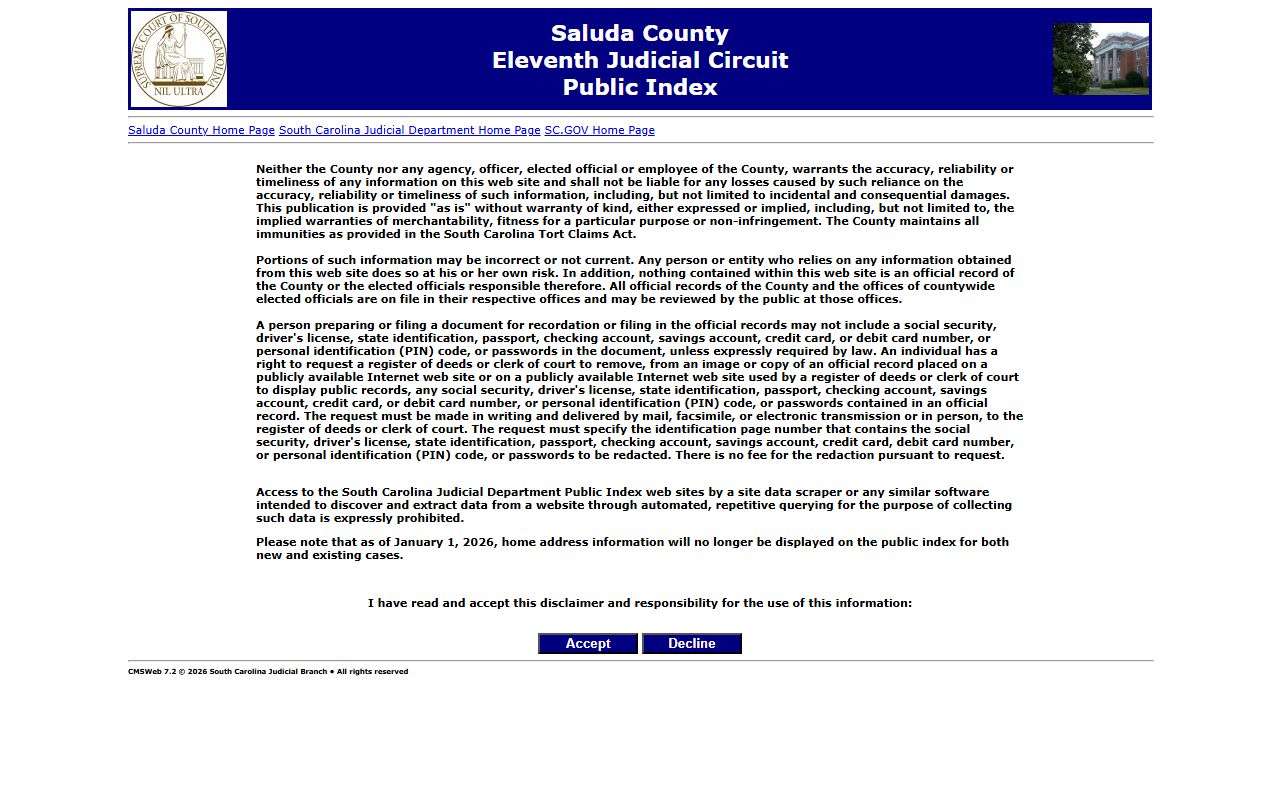
The screenshot shows the official court index used after a jail arrest, not a commercial background-search page or a county booking gallery.
Court Search Fields to Check
The direct Public Index form was not fully readable in static source, so search fields should be treated as portal-dependent. The official gateway and Public Index path still support the practical search sequence below.
| Search Field | How to Use It | Saluda Note |
|---|---|---|
| County | Select Saluda County from the Judicial Branch gateway. | Saluda is listed under the Eleventh Judicial Circuit. |
| Case Number | Use the exact court case number when known. | Best for avoiding name-match errors. |
| Party Name | Search defendant last name and first name. | Useful when only the arrest name is known. |
| Court Type | Filter by circuit, magistrate, or other court category if the portal presents that option. | General Sessions and magistrate matters can follow different paths. |
| Date Range | Use arrest, filing, or hearing dates when available. | Helpful when a common name returns multiple cases. |
How Charges Get Filed After an Arrest: Warrant, Information, and Indictment
A Saluda County arrest can begin with an officer's charge, an arrest warrant, or a bench warrant tied to an existing court case. That does not mean the first booking label is the final court charge. In General Sessions cases, the Eleventh Circuit Solicitor can proceed, amend, reduce, dismiss, or add charges depending on the evidence and procedural posture. An indictment is a grand-jury charging document commonly associated with serious offenses. The court record is the better source for the formal charge and case disposition.
| Complaint or Warrant | Information | Indictment | |
|---|---|---|---|
| Filed By | Law enforcement or prosecutor, with judicial authorization where required. | Prosecutor when permitted by procedure. | Grand jury after prosecutor presentation. |
| Common For | Initial custody, probable-cause allegations, and some magistrate-level matters. | Cases where the prosecutor files a formal accusation without grand-jury indictment. | Many serious General Sessions felony prosecutions. |
| Record Role | May explain why the person was arrested or held. | Sets out a filed prosecutorial charge. | Creates or updates the formal felony charge path. |
| Why It Matters | Booking language can be preliminary. | Shows the solicitor's charging decision. | Often controls how the case proceeds in circuit criminal court. |
Charge Status in Court Records After a Jail Arrest
Charges can change after booking. A jail intake record may show what the arresting agency listed at the time of confinement, while the court record may later show a different charge, a reduced charge, a dismissal, a bench warrant, or a final sentence. Read each charge row on the Public Index separately, then compare it with the bond entry, court dates, and disposition fields.
| Status | What It Means | What to Check Next |
|---|---|---|
| Pending | The charge is still open and no final disposition is shown. | Review the next court date, bond status, and any attorney or solicitor entries. |
| Amended or Reduced | The filed charge changed from the earlier version or moved to a lesser charge. | Compare the original charge description with the current charge and disposition. |
| Dismissed | The court record indicates the charge did not proceed to conviction. | Check whether other charges from the same arrest remain pending. |
| Nolle Prosequi | The solicitor declined to continue prosecution on that charge. | Confirm whether the entry applies to one charge or the entire case. |
| Convicted or Guilty Plea | The case or charge ended with a conviction by plea or verdict. | Review sentence, probation, fine, and custody-transfer information if shown. |
Bond and Release After an Arrest
South Carolina bond law is generally found in Title 17, Chapter 15. In Saluda County, bond may be addressed by a magistrate, municipal judge, or higher court depending on the charge and jurisdiction. The practical local sequence is to confirm custody with Saluda County Detention Center, check whether a bond has been set, then verify court entries through the Saluda Magistrate Court or Public Index. If another agency has a hold, posting a local bond may not cause release.
| Bond Type | How It Works | Local Caution |
|---|---|---|
| Cash Bond | Money is posted as security for court appearance. | Saluda's jail-bond payment policy was not published online; verify accepted methods. |
| Surety Bond | A licensed bondsman or surety guarantees the defendant's appearance. | South Carolina still has commercial bonding channels, but local procedure must be confirmed. |
| PR or Own Recognizance | Release is based on a promise to appear and comply with conditions. | Conditions may still appear in the court record. |
| No-Bond Hold | The court does not authorize release under ordinary bond. | Often requires a later court order or resolution of another hold. |
| Detainer or Agency Hold | Another county, SCDC, federal agency, probation, parole, or ICE may seek custody or notice. | Local bond does not necessarily clear the separate hold. |
Warrants That Lead to an Arrest
No official Saluda County Sheriff's Office public active-warrant list, warrant-search form, or most-wanted warrant database was located. The sheriff's office can route general warrant questions, and the detention center can confirm whether someone has already been arrested and booked. The Public Index may show bench warrants, failures to appear, and court dates once a court case exists, but it should not be treated as a complete active-warrant search for every law-enforcement warrant.
Common warrant-related records include arrest warrants, bench warrants for failure to appear, search warrants that do not necessarily create jail custody, fugitive holds from another jurisdiction, and probation or parole violation warrants. If a person may have an active warrant, legal advice is safer than trying to resolve uncertainty by appearing in person without preparation.
Charges vs. Convictions
An arrest and a charge are not the same as a conviction. Public court records after a jail arrest may show accusations before they are tested in court. A conviction requires a guilty plea, verdict, or other qualifying judgment. This distinction matters for employment, housing, licensing, and personal background research because a dismissed charge should not be described as a conviction.
| Charge | Conviction | |
|---|---|---|
| Stage | Accusation filed or listed in court. | Final finding by plea, verdict, or judgment. |
| Proof Level | Based on probable cause or prosecutorial filing. | Requires proof beyond a reasonable doubt or an admitted plea. |
| Record Meaning | Shows what was alleged after the arrest. | Shows the charge outcome became a criminal judgment. |
| What Can Change | May be amended, reduced, dismissed, or nol prossed. | May be followed by sentence, probation, appeal, or eligible expungement review. |
Sealed vs. Expunged Arrest and Court Records
South Carolina expungement provisions are in Title 17, Chapter 22, Article 9. The Eleventh Circuit Solicitor's Office publishes expungement information, making the solicitor a key local routing point after a Saluda arrest ends in a dismissal, qualifying diversion result, or other eligible disposition. Expungement is eligibility-driven and case-specific; the fact that a case was dismissed does not mean every copy in every public or private database disappears automatically.
| Sealed | Expunged | |
|---|---|---|
| Visibility | Restricted from ordinary public access. | Removed from public access or destroyed as directed by law and order. |
| Law Enforcement | May retain limited access depending on the record and order. | May have very limited exceptions depending on statute and agency role. |
| Eligibility | Depends on court order, confidentiality law, or record type. | Depends on South Carolina expungement law and the final case disposition. |
| Where to Start | Ask the record-holding court or agency about the restriction. | Review solicitor and court expungement procedures for the Eleventh Circuit. |
SLED, Public Index, and Background Check Limits
SLED criminal records checks are statewide criminal-history tools. The Public Index is a court-case lookup tool. The detention center is the current-custody source. Those three sources can overlap, but they are not interchangeable. A recent Saluda jail arrest may be confirmed by the jail before a court case appears online, while an older conviction may be found through a criminal-history channel even when the person is no longer in jail.
Important: This site is not a consumer reporting agency and must not be used for FCRA-covered decisions.
Restricted Court Records After an Arrest in Saluda County
Not every record connected to an arrest is publicly available. South Carolina juvenile justice law supports caution around juvenile records. FOIA exemptions may protect active investigative records, security-sensitive information, victim information, medical details, and other confidential material. The Judicial Branch also notes that home address information stops displaying on the public index for new and existing cases as of January 1, 2026. When a record is missing from the Public Index, the reason may be timing, court type, redaction, confidentiality, expungement, or simple portal limitations rather than proof that no arrest or case exists.
Public Record Search
Sponsored Results